Read the following case and answer the questions that follow:
Amit took two boiling tubes, he added about 2 grams of a green coloured metal salt (A) in the first tube and 2 grams of a white coloured metal salt (B) in the second tube. Both the tubes were heated by holding them with a pair of tongs. Smell of burning sulphur was observed in first test tube, whereas brown gas was emitted in the second test tube.
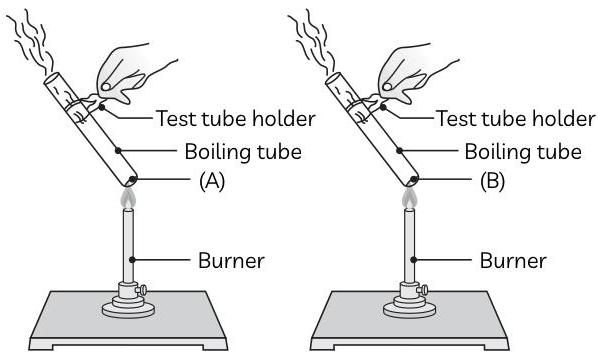
(A) The salts ‘(A)’ and ‘(B)’ are:
(a) ferrous nitrate and lead sulphate, respectively.
(b) ferric oxide and lead nitrate, respectively.
(c) ferrous sulphate and lead nitrate, respectively.
(d) ferric oxide and lead sulphate, respectively.
(Analyse)
(B) Assertion (A): Green coloured ferrous sulphate crystals on heating, first changes to dirty white and then to brownish black.
Reason (R): Ferrous sulphate crystals contain seven molecules of water of crystallisation.
(a) Both (A) and (R) are true, and (R) is the correct explanation of (A).
(b) Both (A) and (R) are true, and (R) is not the correct explanation of (A).
(c) (A) is true but (R) is false.
(d) (A) is false but (R) is true.
(C) What are the products formed when green coloured metal salt (A) is heated? (Remember)
(D) On heating white coloured metal salt (B), two gases are evolved, one is colourless and the other is brown in colour. Which gases are these? (Understand)
(E) In which of the following category will you put the reaction of heating ferrous sulphate and lead nitrate?
(I) Decomposition reaction
(II) Combination reaction
(III) Endothermic reaction
(IV) Exothermic reaction
Options:
(a) Only (I)
(b) Only (II)
(c) Both (I) and (III)
(d) Both (II) and (IV)
Ans. (A) (c) ferrous sulphate and lead nitrate, respectively.
Explanation: The green coloured metal salt (A) in the first test tube is ferrous sulphate as it is green in colour and when heated, it decomposes to form ferric oxide, sulphur dioxide and sulphur trioxide, which produce smell of burning sulphur.
Equation for the reaction taking place is:
The white coloured metal salt (B) in the second test tube is lead nitrate, as brown fumes of a gas is emitted when it is heated, which are of nitrogen dioxide.
Equation for the reaction taking place is:
(B) (a) Both (A) and (R) are true, and (R) is the correct explanation of (A).
Explanation: Ferrous sulphate crystals which seem to be dry contain seven molecules of water of crystallisation. When we heat the crystals, this water is evaporated and the salt turns white. On further heating, a decomposition reaction takes place and forms solid ferric oxide which is brownish black in colour.
In this reaction, a characteristic odour of burning of sulphur is also observed.
(C) When green coloured metal salt (A), i.e., ferrous sulphate crystals are heated, it undergoes decomposition reaction to form ferric oxide, sulphur dioxide and sulphur trioxide, respectively.
(D) When white colour metal salt (B), i.e., lead nitrate is heated, it undergoes decomposition reaction to form lead oxide, along with the evolution of gases, nitrogen dioxide and oxygen, respectively. In this reaction, oxygen is the colourless gas, while nitrogen dioxide is the brown-coloured gas, released along with oxygen.
(E) (c) Both (I) and (III)
Explanation: As both ferrous sulphate and lead nitrate absorb heat and undergo decomposition, these reactions are endothermic reactions and are also known as thermal decomposition reactions.